16 Current measurements
Power spectra, Cosmological parameters, Primordial B-mode, Planck
16 Current measurements
Now let us take a look at the current measurements of the CMB.
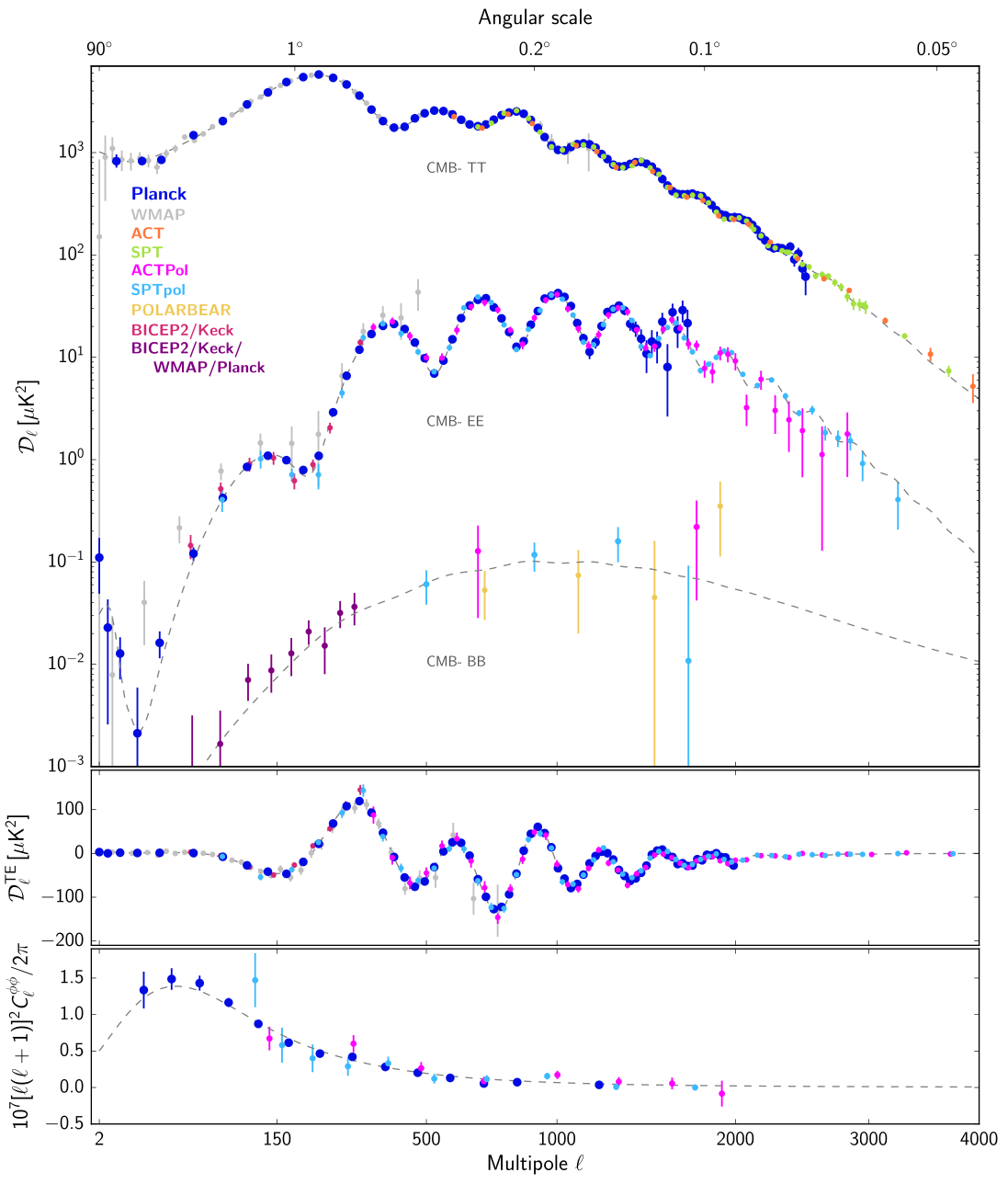
In fig. 16.1, we can see the spectra. We can see most of these are measured very accurately over a wide range of scales. In particular, the \(TT\) spectrum at \(\ell \lesssim 1600\) is measured approaching the cosmic variance limit meaning that observationally we cannot further improve the error-bar beyond a factor of a few fundamentally.
As we explore each of the curves, we can see boundaries that can be pushed in future CMB experiments. For example, the tails and the lensing constraints can be improved, resulting in better understanding of Neutrino physics such as the effective number of species, sum of Neutrino masses, and its mass hierarchy.
Furthermore, we can see that the B-mode polarization, where evidence is first reported by POLARBEAR, is the least constrained. Not shown on the graph, the primordial B-mode at \(\ell \lesssim 100\) is not measured yet. This is the science goal of many upcoming CMB experiments including LiteBIRD. This primordial B-mode is often parameterized by the tensor-to-scalar-ratio \(r\). Let us see what can be achieved by measuring this.
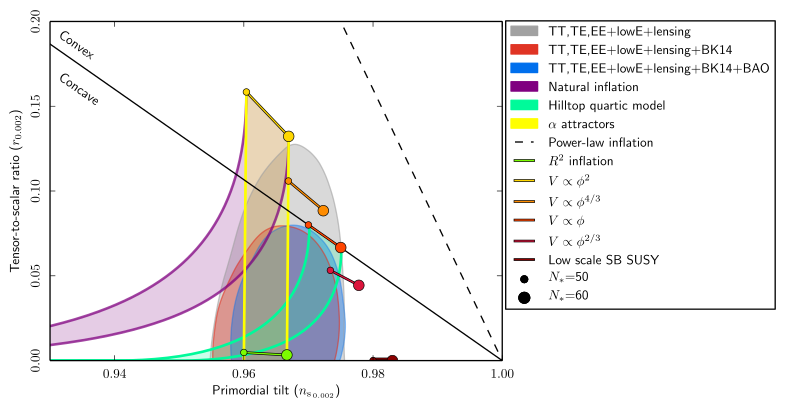
In fig. 16.2, the 2 axes are \(r, n_s\). As we mentioned in chapter 3, we know that \(n_s < 1\) is a sign of inflation. But it alone cannot break the degeneracy in inflationary models as seen in this plot. This \(r\) offers us a chance to glimpse into the details or even to falsify inflationary models.