15 Posterior estimation from the data and its likelihood
Likelihood and inference, Cosmological parameters
15 Posterior estimation from the data and its likelihood
Now that is where the fun begins. From here, we can start to infer about our universe.
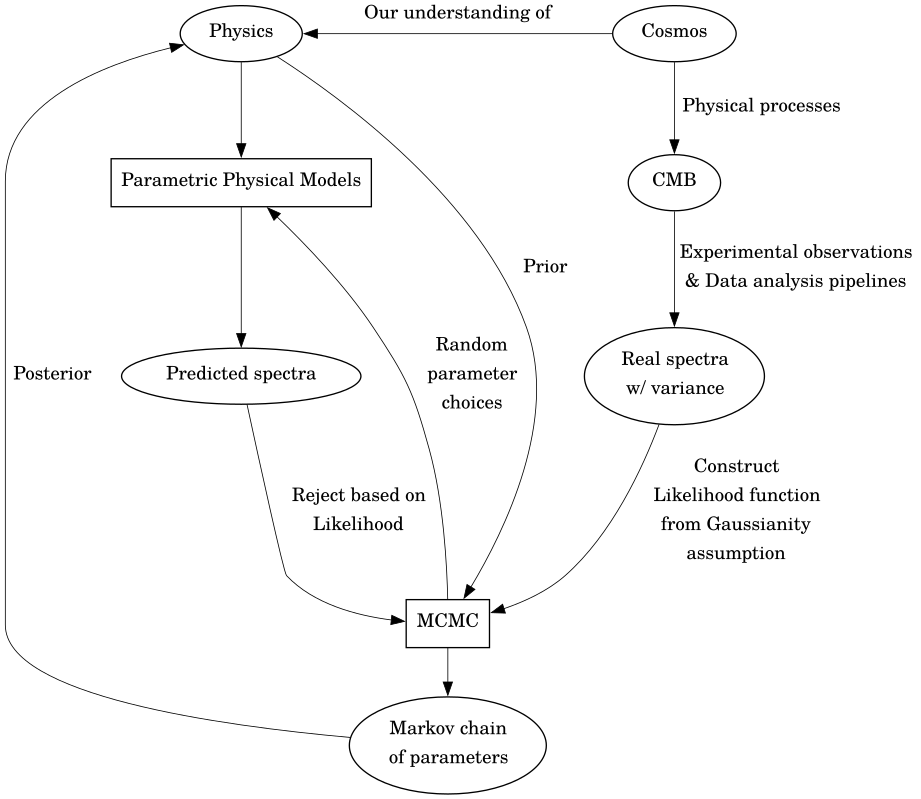
In Fig. 15.1, the pipeline enables us to obtain the CMB power-spectra with covariance information.
Our theoretical understanding of the Universe enables us to build parametric Physical models, which include cosmological parameters such as those in the ΛCDM model including matter compositions & spatial curvature, new physics, or parameterized systematics such as foreground components & their spectral indices.
Gathering all the pieces, we can perform Markov chain Monte Carlo (MCMC) method to “invert” from observed power-spectra to parameters. It works like this:
- construct a likelihood function using the measured power-spectra assuming Gaussianity,
- write down the prior information from what we already know in physics, such as the Universe is flat from other measurements,
- make random parameter choices and use our model to predict the output power-spectra,
- accept or reject the choice based on the likelihood and prior,
- obtain a Markov chain of parameters,
which gives us an approximate maximum a posteriori (MAP) probability estimation.
This leads to refinements of our understanding of the Universe or even discovery of new physics depending on the significance of its parameters.