6 The CMB power-spectra
Power spectra, Spherical harmonics, CMB polarization, Gravitational lensing
6 The CMB power-spectra
As these maps are on a \(2\)-sphere, we can perform spherical harmonics transformation on these, and calculate the \(2\)-pt correlation function between them.
We can form \(TT\), \(EE\), \(BB\), and \(TE\), \(EB\), \(TB\) combinations out of them. And by underlying parity symmetry, we expect \(EB\) and \(TB\) to be exactly zero1. Hence, we are left with \(TT\), \(TE\), \(EE\) & \(BB\).
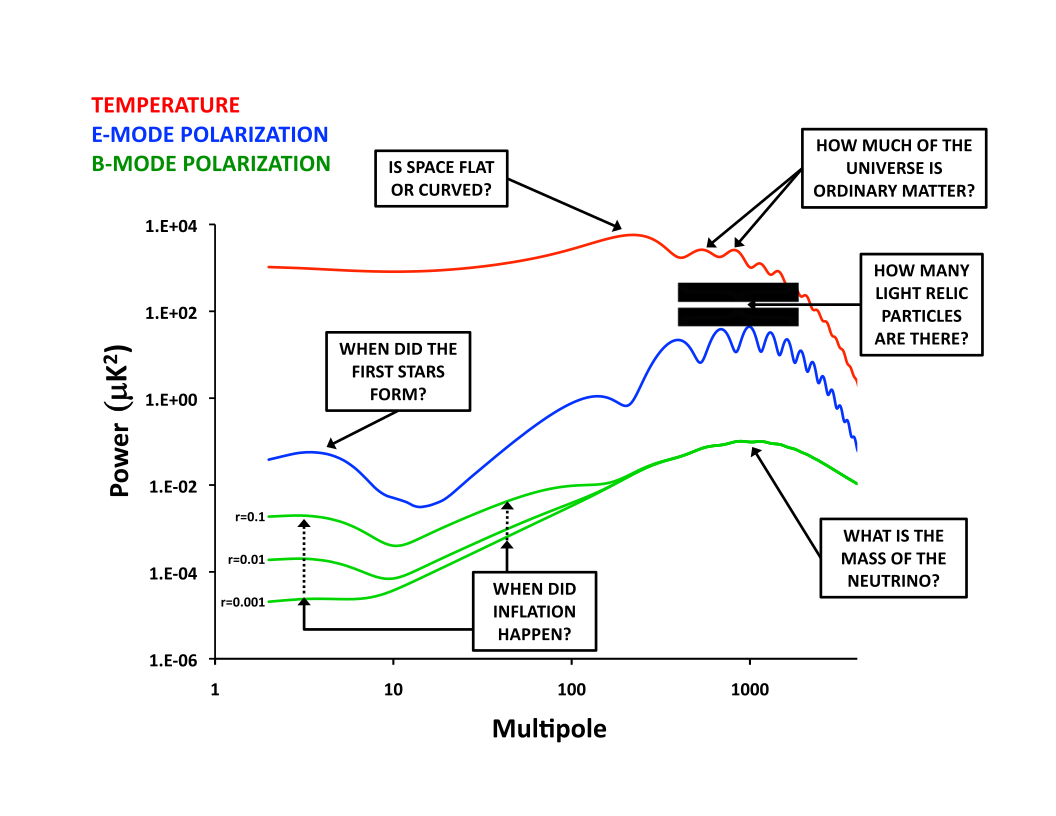
fig. 6.1 shows the \(2\)-pt correlations (also known as power-spectra) we theoretically expect. This only depends on the initial parameters unlike the maps.
In this plot we start to see how CMB can be used to extract information about our Universe. Here the horizontal axis is the multipole, roughly corresponding to inverse angular scale. For example, on the top left the low-\(\ell\) \(TT\) has a Sachs-Wolfe Plateau, corresponding to the horizon scale. On the right, \(TT\), \(EE\) has these oscillatory peaks, a signature of the Baryon Acoustic Oscillations (BAO) between gravity and pressure of all matters. Hence it is sensitive to spatial curvature and matter compositions including matter, dark matter, and dark energy. On the bottom, we see that \(BB\) is the weakest, as it can only be contributed by gravitational effects. For example, on the right we have the high-\(\ell\) \(BB\) dominated by the gravitational lensing of \(EE\), and is sensitive to the mass of neutrino.
Footnotes
Similar to the absence of circular polarization in the CMB, and in fact most if not all null-hypothesis in physics, it can and should be experimentally tested, and discovery can lead to new physics. This phenomenon of non-zero \(TB, EB\) is known as cosmic birefringence, and upper limits have been placed by experiments such as Planck Collaboration, Aghanim, et al., “Planck Intermediate Results”. Potential new physics that can produce cosmic birefringence includes parity violation, Lorentz violation, or axion-photon mixing (Particle Data Group et al., “Review of Particle Physics”).↩︎