12 Systematics characterization and mitigation strategies
Systematics, Time-ordered data, Filtering, Masks and apodization, Foregrounds, Planck
12 Systematics characterization and mitigation strategies
12.1 Timestream processing
Now that we know how we generally obtain a map, and we understand its statistical properties, we turn our attention to systematics.
In fact, before we pass the TOD to the mapmaker, we need to do some cleanup first. For example, detectors have glitches from sources such as cosmic rays as in fig. 12.1, which are not part of our sky signal and thus should be removed.
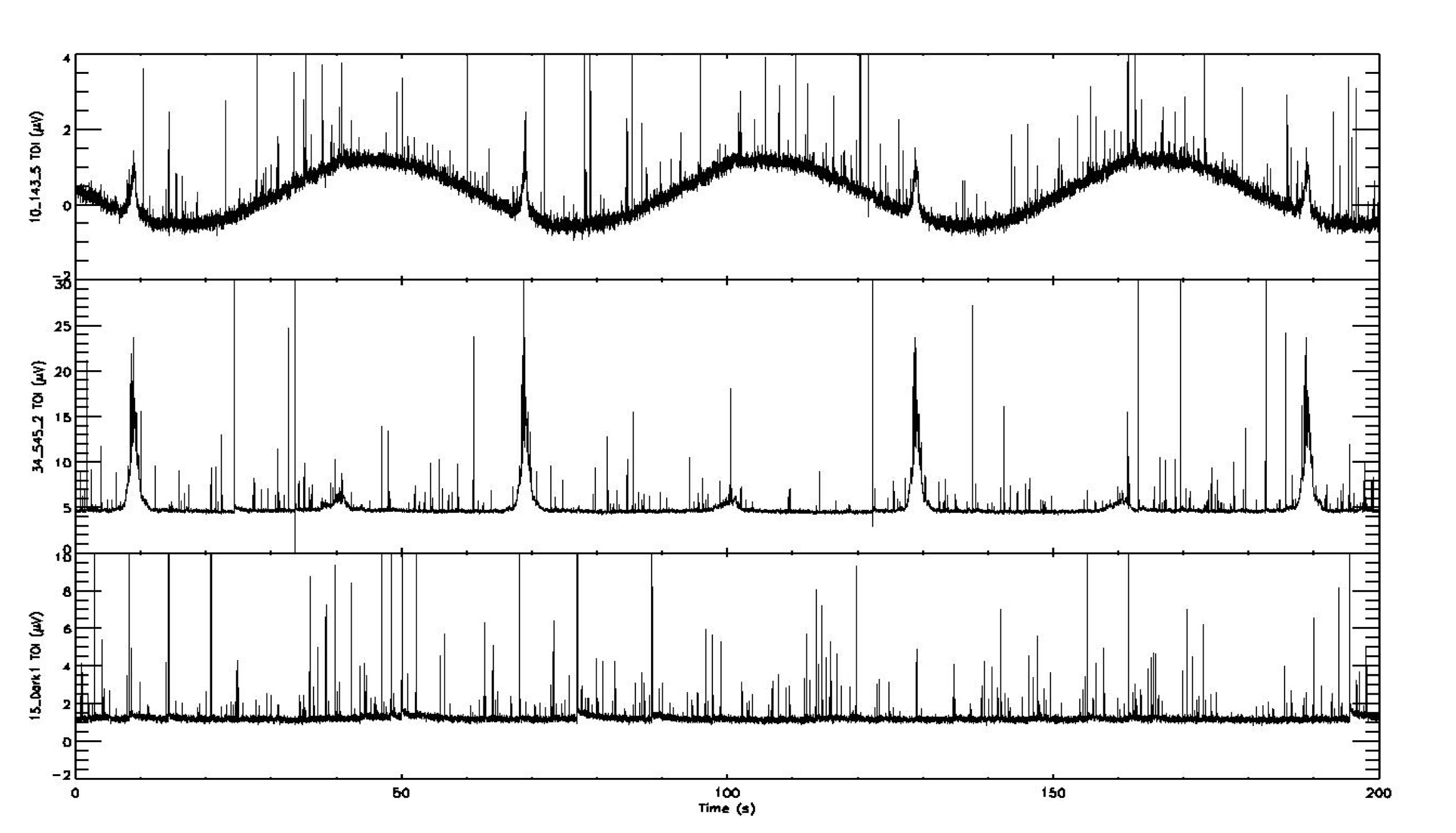
There is also scan-synchronous signal, such as ground pickup. As the telescope is scanning the sky, the signal from the surroundings of the telescope can contaminate the sky signal it is observing. One mitigation strategy is to construct a ground template and subtract that from the TOD.
Other examples that we have already mentioned are I-to-P leakage subtraction, high pass filtering, foreground masking when building templates.
12.2 Map-domain processing
Having the TOD made into maps, not only did we perform data compression, but also it boosts the signal-to-noise ratio. Hence, we can perform further systematic mitigation.
It can be as simple as masking out the foreground such as point sources and our galaxy as in fig. 5.1. And if we have multi-frequency observations, we can extract foreground components as in fig. 8.1, fig. 8.3, and fig. 8.4.