17 Next stage of CMB experiments
Noise, Detectors and readout, High-performance computing, Systematics, Ground-based observation, Error bars and sensitivity
17 Next stage of CMB experiments
In order to achieve these goals, there are a lot of upcoming challenges.
Regardless of the science goal of a particular CMB experiment, a common enemy is noise. The remaining battlegrounds as we have seen are weaker signals. And as we are probing weaker and weaker signals, we need to achieve lower noise levels.
As our detectors are already photon-noise limited, it means that we need to increase the number of detectors. This means inevitably the CMB data volumes will grow, and the growth is exponential as we can see in Fig. 17.1.
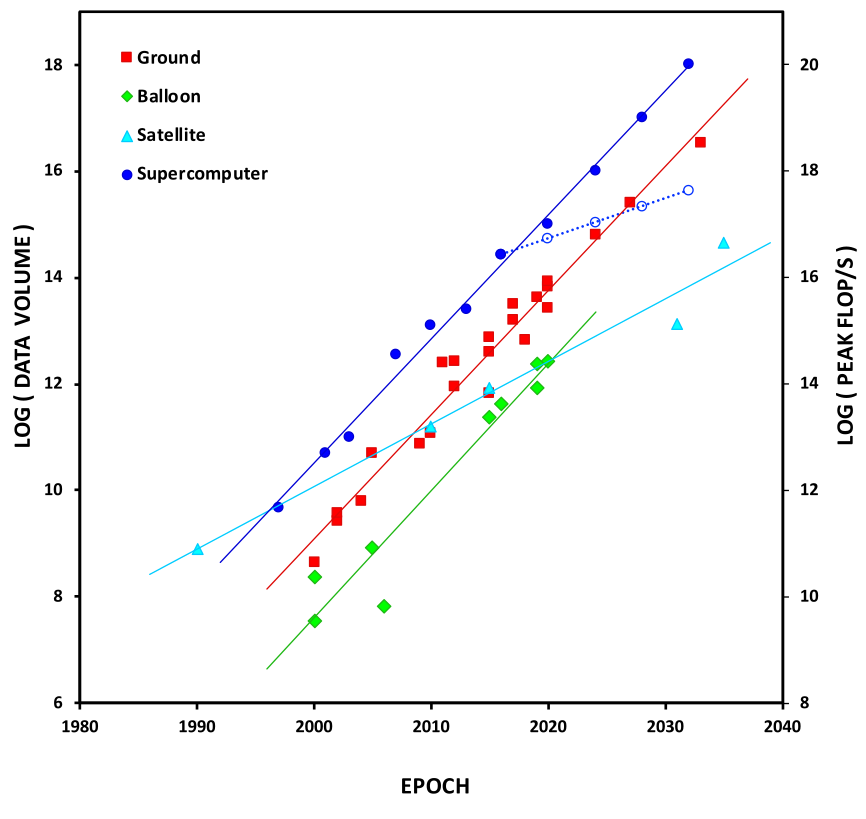
In general, all the datasets are growing exponentially across different sectors. On the other hand, HPC growth is slowing down as we are approaching the end of Moore’s law, basically because we are hitting a Physical limit there.
In fact, if we look at the ground-based observations, the CMB data growth will soon surpass the HPC growth.
This means we need to stay on the cutting edge in hardware and software to deliver the computational requirements of CMB analysis.
Moreover, systematics do not average down. As we are probing weaker signals, systematic effects that were once negligible might matter now. This imposes challenges to both experimental design and analysis software design to minimize, quantify, and mitigate these systematic effects.
With the big picture in our mind, let us focus on my research in 2 specific CMB experiments—the POLARBEAR experiment and the LiteBIRD experiment. In part IV, we will briefly introduce the POLARBEAR experiment, a ground based CMB experiment in the past decade. In part V, we will focus on my research topic on the large-patch high-\(\ell\) \(B\)-mode measurement. Lastly, in part VI, we will study the crosstalk systematic effects in a future satellite-based CMB experiment LiteBIRD.