32 The LiteBIRD satellite
LiteBIRD, Primordial B-mode, Detectors and readout, Crosstalk, Systematics, Scanning strategy, Error bars and sensitivity
32 The LiteBIRD satellite
LiteBIRD stands for Lite (Light) satellite for the studies of B-mode polarization and inflation from cosmic background Radiation Detection.
32.1 Introduction
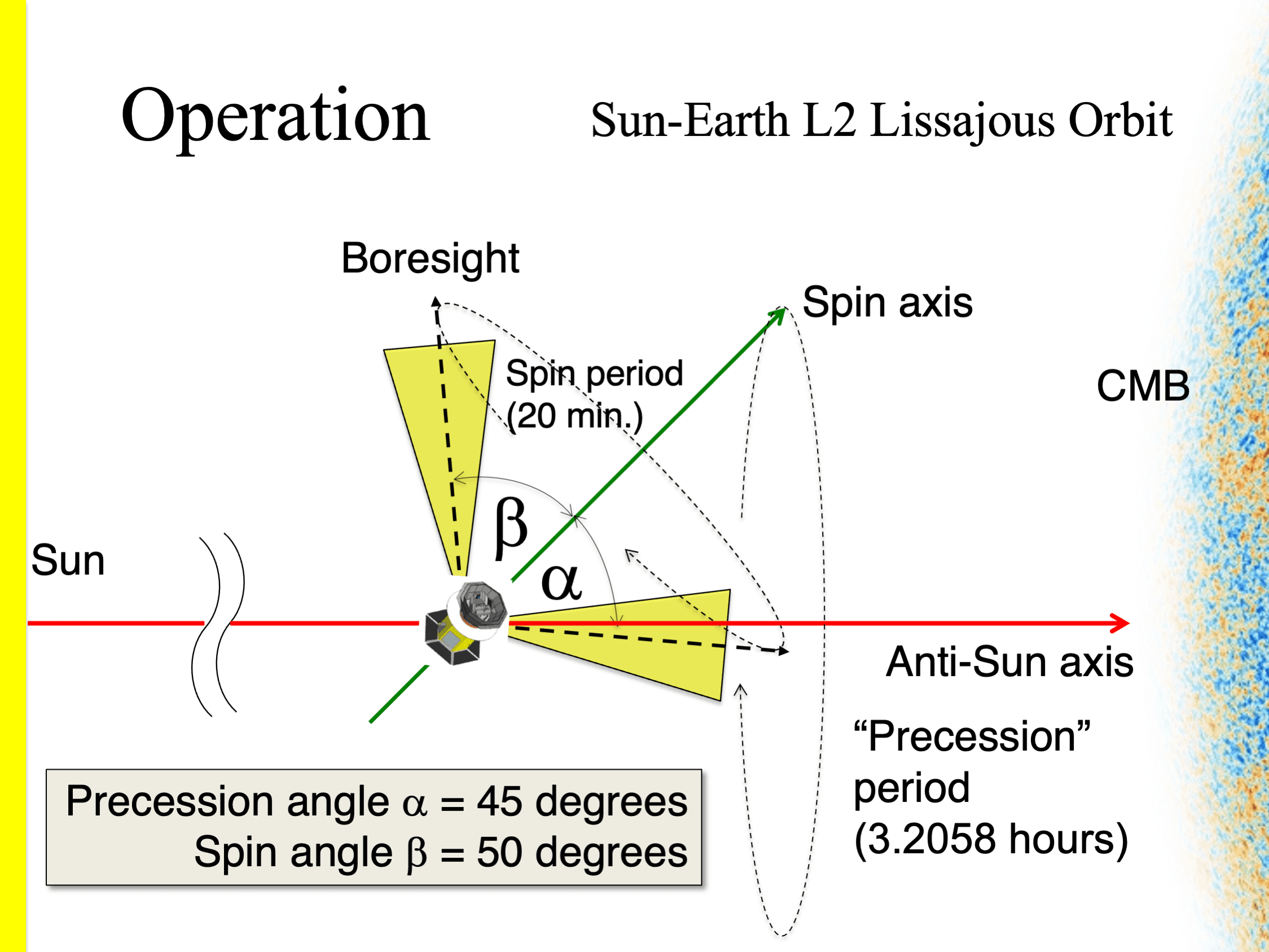
LiteBIRD is a satellite-based CMB experiment expected to launch in the late 2020s. It will be the successor of Planck and will become the 4th satellite dedicated to CMB observation. Like its predecessors since the 2nd generation WMAP, it will orbit around L2 point with a quasi-stable Lissajous orbit as shown in fig. 32.1, far away from the contamination by the Earth and the Moon.
32.2 Science target
The primary science target of LiteBIRD is the primordial \(B\)-mode and hence it is a probe of inflationary physics.
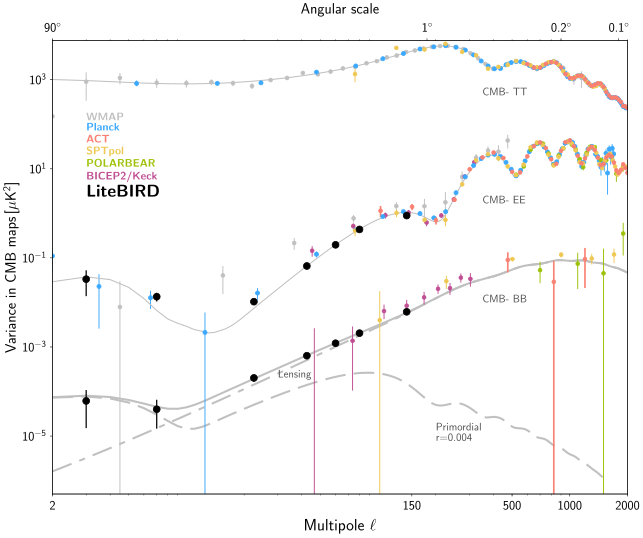
In fig. 32.2 & fig. 32.3, which can be compared to fig. 16.1 & fig. 16.2, they show the projected sensitivity of LiteBIRD in terms of the B-mode spectrum, parameterized by the tensor-to-scalar ratio \(r\).
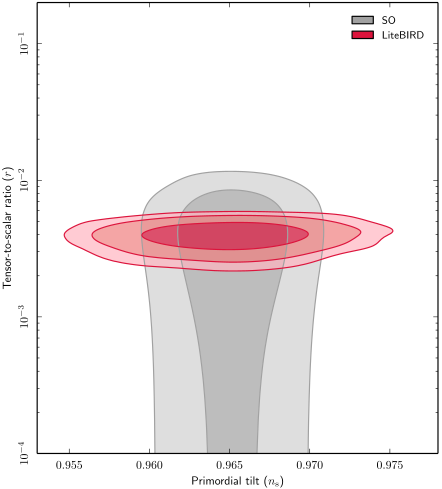
The current constraint is \(r < 0.044\). LiteBIRD aims to constrain \(\delta r < {1\times 10^{-3}}\). This can either make a discovery or rule out well-motivated inflationary models.4
This makes it one of the most exciting CMB experiments in the coming decade. And to date, hundreds of scientists around the globe are working on the project to achieve this goal.
32.3 Multiplexed readout system
LiteBIRD is designed to be a 3-year mission, with the current design holding 4508 detectors; reading out data from all those detectors is challenging. These TES bolometers are daisy-chained together using digital frequency-domain multiplexing (fMUX) through superconducting quantum interference device (SQUID) to achieve simultaneous readout.
For example, in POLARBEAR, 8 bolometers are chained through SQUID. In LiteBIRD, the current baseline design is to chain around 68 bolometers, with possibly more in the order of 100s as the design improves.
This is also a general trend in CMB experiments. As seen in chapter 17, the number of detectors is growing exponentially. For reasons laid out in Montgomery et al.5 one of the primary limitations in growing the number of detectors is cryogenic cooling limitations, where multiplexing is an essential part of the solution. Hence, we are going to see increasingly larger mux factor, translated into the size of the crosstalk matrix. It makes the crosstalk systematics increasingly more important to be understood and mitigated.
32.4 Crosstalk between detectors
With so many detectors chained together, crosstalk between them can contaminate our signal.
For example, We would like to chain detectors across different observing frequencies for fault tolerance such that if a whole SQUID is down, we are not knocking out a whole observing frequency or wafer. The presence of crosstalk across different frequency channels will mix different amounts of foreground components into our resultant maps. We typically form individual frequency maps and from there we cross-correlate to estimate the foreground systematics, such as how it is analyzed in Planck. This mixing will break our model and systematics can bias our results.
To solve this problem, it is a joint effort between the hardware and software team. The experimentalists can reduce the crosstalk in the design, and provide realistic simulations on the amount of crosstalk expected from a design. The data scientists can take the crosstalk matrix as an input and simulate the amount of bias injected into the signal.
This feeds back into the hardware design process which informs us if it can achieve our science goal.
Also, in terms of software development, we can devise mitigation strategies in how we can reduce the amount of bias.
Moreover, a given hardware design has a huge parameter space to explore. For example, in our current design for a certain SQUID, it is required for around 60 detectors to be chained across 3 wafers with around 20 detectors each. The exact ordering within a SQUID is totally free. This is then an optimization problem for us to simulate the amount of bias subject to the same requirement and optimize the configuration to provide feedback to hardware design.
In chapter 33, we will see how to generate the crosstalk matrix from SQUID parameters. In chapter 34, a map-domain crosstalk model is presented together with a set of assumptions which is fulfilled approximately in the case of LiteBIRD. In chapter 35, an implementation of crosstalk simulation is presented in the framework of TOAST. In chapter 36, crosstalk systematics simulations in the example of LiteBIRD are performed, and a mitigation strategy is presented.