\(\newcommand{\cth}[1]{C_{b, #1}^\text{th}} \newcommand{\cL}{\mathcal{L}} \newcommand{\bC}[1]{\mathbf{C}_{#1}} \newcommand{\hbC}[1]{\mathbf{\hat{C}}_{#1}} \newcommand{\hC}[1]{\hat{C}_{#1}} \newcommand{\hCoverC}[1]{\hbC{b} \bC{b}^{-1}} \newcommand{\matrixToComponent}[1]{\mathbf{#1}_b = #1_b^{XY, \text{ total}}} \newcommand{\BBonly}[1]{\hat{C}_b^{BB, \text{#1}} \delta^{XB} \delta^{YB}} \newcommand{\componentForm}[2]{ {#1}^{XY} = C_b^{XY, \text{ total, #2}} + \hat{N}_b^{XX} \delta^{XY} }\)
4 The CMB spectrum
Keywords
Big Bang cosmology
4 The CMB spectrum
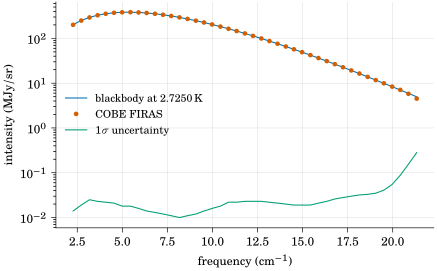
As mentioned in part I, when the photons were last scattered during recombination, they were in thermal equilibrium. Fig. 4.1 shows the measurement of the CMB spectrum by COBE’s FIRAS instrument1 which is in close agreement with a blackbody prediction with a temperature of \({2.7255 \pm 0.0006\,\mathrm{K}}\). The last scattering happened at around \(z \approx 1100\), corresponding to a temperature of \({\sim 3000\,\mathrm{K}}\).
It also shows that the CMB is incredibly smooth. No matter which part of the sky we are looking at, it is the same temperature within this error-bar.