5 The CMB anisotropy
CMB polarization, Planck
5 The CMB anisotropy
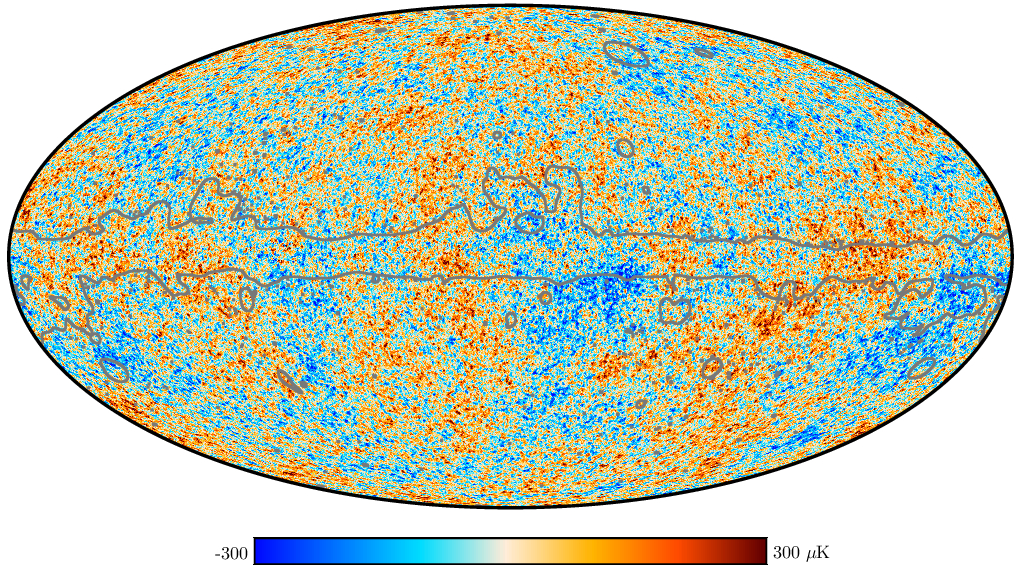
In fact, as seen in the intensity map of CMB in fig. 5.1, the fluctuation of the intensity is about 1 part in \({10^{5}}\).
Moreover, it is known that light waves can be polarized. The primary mechanism to generate polarization is through Thomson scattering of the anisotropic intensity. As Thomson scattering generates only linear polarization, circular polarization is therefore not expected to be present2. Therefore, we can focus our attention to the linear polarization of the CMB.
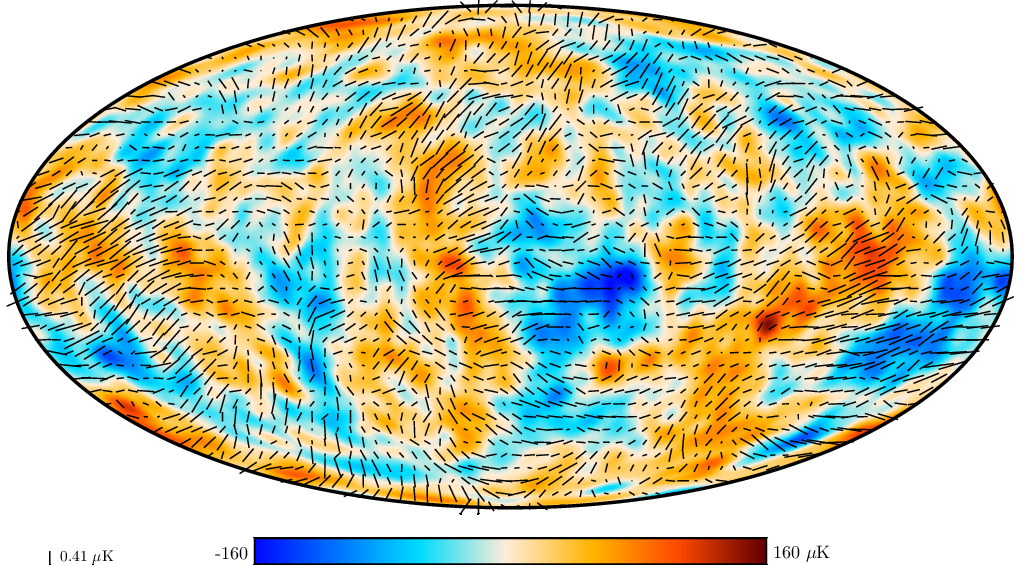
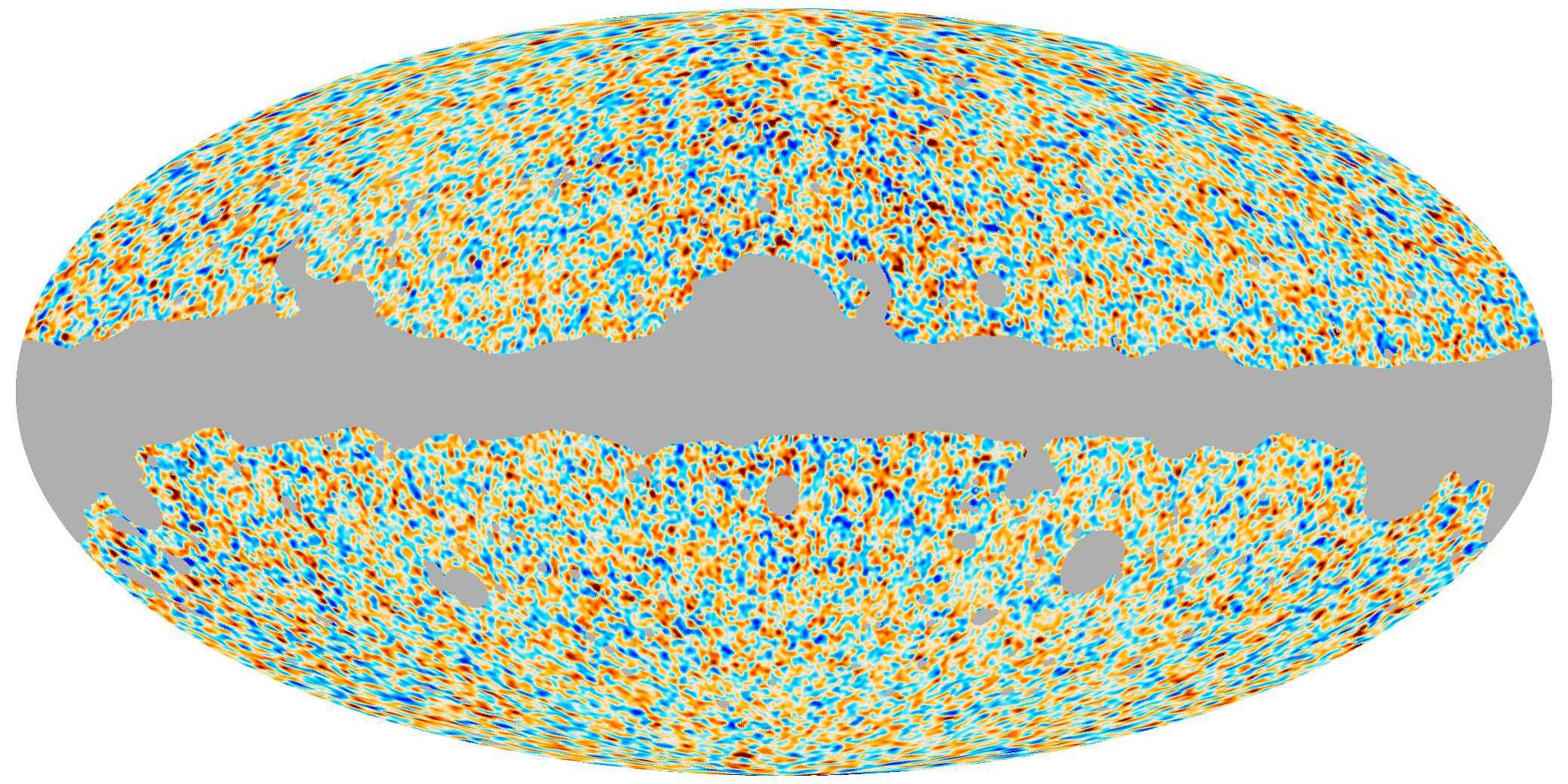
Fig. 5.2 shows the smoothed intensity overlaid with the polarization arrows indicating the polarization direction. First, we can see that the arrows and color are quite correlated. And the arrows mainly have divergent patterns, but not so much of a curl. In fact, it is a good idea to decompose the \(2\) degree of freedom from the linear polarization into this divergence and curl pattern, known as the E-mode and B-mode of the CMB, as this is independent of the choice of coordinate system. In fig. 5.3, we can visualize B-mode using a template constructed by Planck.
Putting all together, \(T\), \(E\) & \(B\) uniquely characterizes the CMB.
Footnotes
Planck Collaboration, Aghanim, Akrami, Arroja, et al., “Planck 2018 Results”.↩︎
This assumption has been experimentally constrained, such as in Nagy et al., “A New Limit on CMB Circular Polarization from SPIDER”. There exist known mechanisms to generate non-zero but tiny contributions of circular polarization in the CMB, such as Zarei et al., “Generation of Circular Polarization of the CMB”; Mohammadi, “Evidence for Cosmic Neutrino Background from CMB Circular Polarization”; King and Lubin, “Circular Polarization of the CMB”; Sadegh, Mohammadi, and Motie, “Generation of Circular Polarization in CMB Radiation via Nonlinear Photon-Photon Interaction”; Montero-Camacho and Hirata, “Exploring Circular Polarization in the CMB Due to Conventional Sources of Cosmic Birefringence”; Inomata and Kamionkowski, “Circular Polarization of the Cosmic Microwave Background from Vector and Tensor Perturbations”.↩︎
Planck Collaboration, Aghanim, Akrami, Arroja, et al., “Planck 2018 Results”.↩︎
Planck Collaboration, Ade, et al., “Planck Intermediate Results”.↩︎