19 The POLARBEAR telescope
POLARBEAR, Ground-based observation, Half-wave plate, Detectors and readout, Beam
19 The POLARBEAR telescope
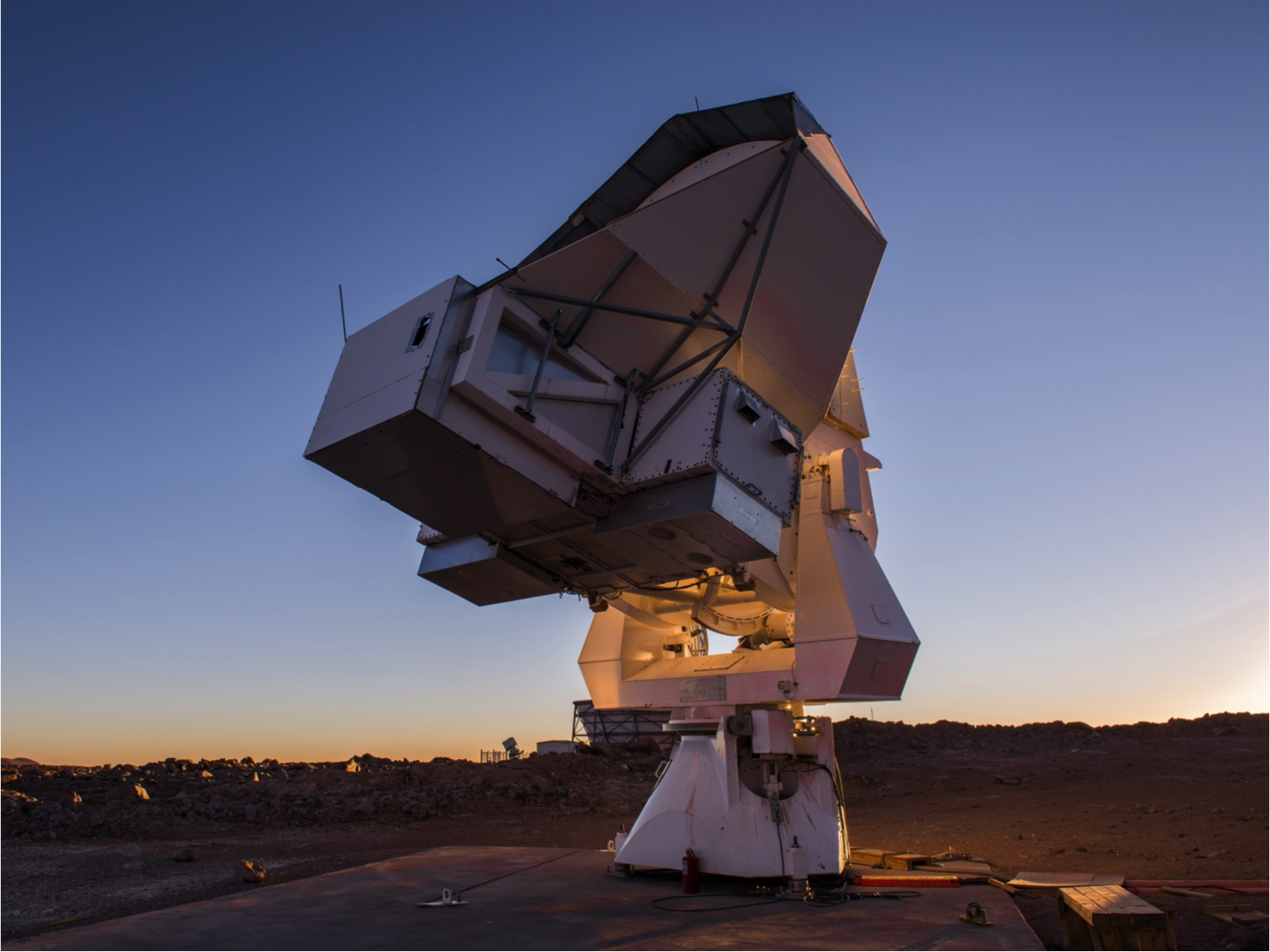
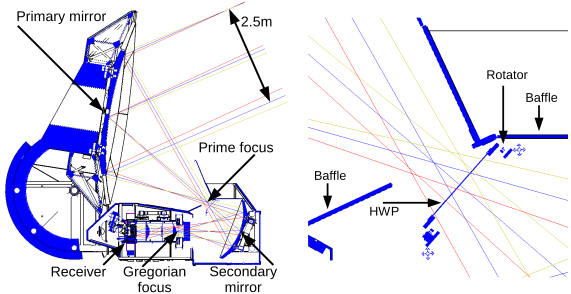
POLARBEAR is a CMB experiment installed on the \({2.5\,\mathrm{m}}\) aperture Huan Tran Telescope as shown in fig. 19.1, located at the James Ax Observatory in the Atacama Desert in Chile3 (see fig. 9.2 and sec. 9.1), with a \({3.5'}\) beam. As shown in fig. 19.2, it has an off-axis Gregorian design with the advantage of a clear aperture.4 It packs 1274 transition edge sensor (TES) bolometers observing at \({150\,\mathrm{GHz}}\).
Detectors are cooled to \({250\,m\mathrm{K}}\), whereas the lenses are at \({4\,\mathrm{K}}\). It achieves \(\text{NET}_\text{array} = {23\,\text{µ}\mathrm{K}\,\sqrt{\mathrm{s}}}\).
POLARBEAR has 5 seasons of observations. In the 1st–2nd seasons (2012–2014), it observed 3 different patches on the sky with a total of \({25{^\circ}^{2}}\) sky coverage. It achieved a sensitivity of \({8.3\,\text{µ}\mathrm{K}\,'}\) in one of the patches named RA23. A B-mode spectrum was constrained at \(500 \leq \ell \leq 2100\), where the 1st season of data provided the first direct evidence of polarization lensing.5
After the 2nd season, a Continuously Rotating Half-Wave Plate (CRHWP) was installed to modulate the polarization signal so that the \(1/f\) noise was reduced to target large scale, low-\(\ell\) signal. Optimally, it should be placed as far skyward as possible to avoid I-to-P leakage caused by the asymmetry in the optical system. But the limitation of HWP technology had put its maximum size to about \({0.5\,\mathrm{m}}\) in diameter. Due to this constraint, the optimal point to place it is between the primary and secondary mirrors6 as shown in fig. 19.2.
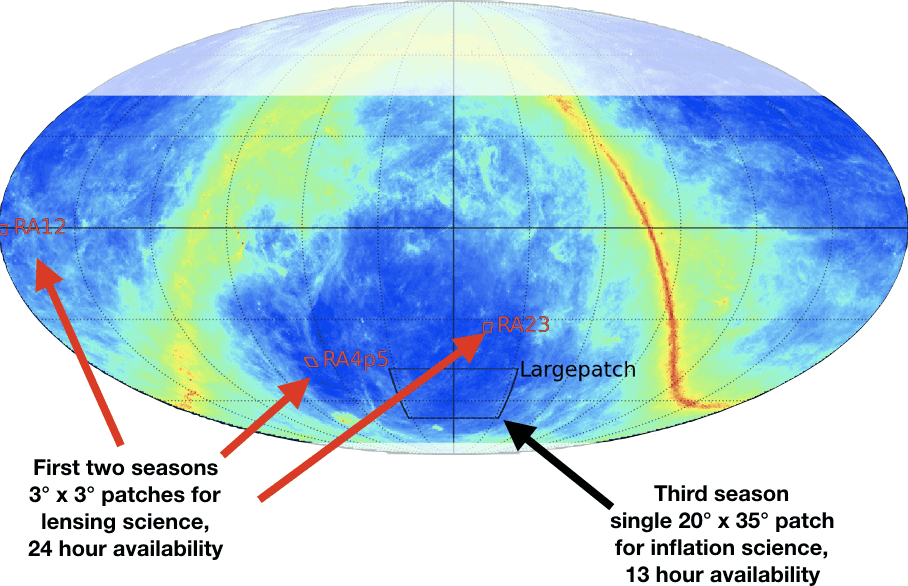
In the remaining 3rd–5th seasons (2014–2017), it observed a sky area of \({670{^\circ}^{2}}\), as shown in fig. 19.3. The presence of the CRHWP and the larger sky area enables us to target low-\(\ell\) science. The resultant observed \(\ell\)-range is \(50 \leq \ell \leq 3000\). We called this informally the “large-patch”. This unique design of a medium aperture telescope with a CRHWP enables us to target both low-\(\ell\) for primordial B-mode and high-\(\ell\) for lensing B-mode. It achieves a sensitivity of \({32\,\text{µ}\mathrm{K}\,'}\).
Footnotes
POLARBEAR collaboration, POLARBEAR Huan Tran Telescope at the James Ax Observatory Located at Cerro Toco in the Atacama Desert in Northern Chile.↩︎
Takakura et al., “Performance of a Continuously Rotating Half-Wave Plate on the POLARBEAR Telescope”.↩︎
The POLARBEAR Collaboration et al., “A Measurement of the Degree-Scale CMB B-Mode Angular Power Spectrum with POLARBEAR”.↩︎
Ade et al., “Measurement of the Cosmic Microwave Background Polarization Lensing Power Spectrum with the POLARBEAR Experiment”.↩︎
Takakura et al., “Performance of a Continuously Rotating Half-Wave Plate on the POLARBEAR Telescope”.↩︎